Showing posts with label Lovebirds. Show all posts

Tuesday, 14 April 2015

Lovebirds and their history

Lovebirds and their history

Lovebirds were a largely unheard of species outside of Africa until Europeans wrote in books and journals about these strange brightly colored birds they had seen while in Africa.
The first Lovebird to be described in detail was the Red Faced lovebird in the early 1600, it was also the first lovebird to be imported into Europe during the 19th century since it was found in more widely in the wild than any of the other species.
Other species of lovebird were imported soon after the Red Faced except the Peach face which was thought to be variant of the Red Faced, although the Peach Faced lovebird was acknowledged by the British Museum in 1793. It wasn't until 1817 that the Peach Faced lovebird was recognized as a separate species of lovebird and were imported into Europe in the mid 1800's

Friday, 10 April 2015

Breeding Lovebirds

Breeding Lovebirds

BEFORE YOU BEGIN
The most important thing to consider when deciding to breed lovebirds is how much time and energy you have. Breeding birds need to be in top condition; they cannot be on seed-only diets or be forced to live in dirty cages. They must be supplied a healthy diet with lots of variety. A good pellet mix like Dr. D’s or Mazuri and a high-quality seed mix like Volkman are only supplements really. It’s the fresh vegetables and grains that will make your birds healthy enough to lay fertile eggs and raise strong babies.

Fischers Lovebirds (Eye-ring Lovebirds)

Fischers Lovebirds (Eye-ring Lovebirds)

Fischers Lovebirds 


The Fischer's lovebird (Agapornis fischeri, synonym Agapornis personata fischeri) is a species of bird in the parrot family.They are named after German explorer Gustav Fischer.

Distribution:

They are native to a small area of east-central Africa, south and southeast of Lake Victoria on the inland plateaus of northern Tanzania. In drought years, some birds move west into Rwanda and Burundi seeking moister conditions.In captivity, they are easy to keep and breed freely. They can be bred in large colonies. They were originally discovered in the late 1800's, and were first bred in the United States in 1926. 

Description:

They are one of the smaller lovebirds, about 14-15 cm in length and 42-58 g weight.
Fischer's lovebirds have green backs, chests, and wings, their necks are a golden yellow and as it progresses upward it becomes darker orange. The top of the head is olive green, and the beak is bright red. The upper surface of the tail has some purple or blue feathers. A. fischeri has a white circle around its eyes. Young birds are very similar to the adults, except for the fact that they are duller and the base of their beak has brown markings.

Monday, 6 April 2015

LoveBird In The Wild

LoveBird In The Wild

http://www.skekek.com/wp-content/uploads/2013/01/Skekek-2616.jpgWild lovebirds are found in various locations in the huge continent of Africa.
Please look at the map below then look at the guide below the map to find out where the lovebird species are located


What Feed You Can Use For Your LoveBird

What Feed You Can Use For Your LoveBird

https://suzandtell.files.wordpress.com/2013/01/101_2128.jpgLovebirds have hooked beaks which means they can eat a variety of seeds and nuts but that is not all you should feed them as feeding them only seeds and nuts can lead to vitamin deficiency.

You should always feed your birds a mixture of seeds, fruits and vegetables to insure a healthy lovebird.

Every day you should offer your lovebird a mix of the following seeds...
Niger, silver millet (not a millet spray), flax, peas, oats; you should also add some canary or budgie seed mix as well

Friday, 3 April 2015

Breeding Lovebirds - How To Breed LoveBirds

Breeding Lovebirds - How To Breed LoveBirds


Breeding lovebirds can be a rewarding, educational and overall challenging experience -- but it's EASY to get started. Provided you have a true and mature pair (at least 10months or older), they will go down to the business of breeding pretty quickly.
The other side of the coin is that bird breeding can also become addictive, expensive, tiring, and heartbreaking. I loved taking care of my breeder lovebirds and especially handfeeding and socializing the babies. Lovebird chicks are so adorable; they love snuggling into your lap or your hand. They are trusting and ever so affectionate. I fell in love with every one of my babies.
The toughest part for me was to find good homes for them. You get rather attached to them, but you cannot keep them all. So the next step is to find good homes for them. I was very dismayed about not finding many homes I felt comfortable with. Many times I wondered if my baby was going to be okay, as I had to "compromise" when it came to what I understood to be a good home. In the end I stopped my birds from breeding by replacing their fertilized eggs with dummy eggs. This was the end of my breeding activity.

Saturday, 21 March 2015

Mutations – Agapornis color mutations


Mutations – Agapornis color mutations

THE PICTURES BELOW ARE FROM BREEDERS AROUND THE WORLD WHO WANTED TO SHARE THEIR BEAUTIFUL BIRDS WITH US, WE ARE GRATEFUL FOR SHARING WITH US …
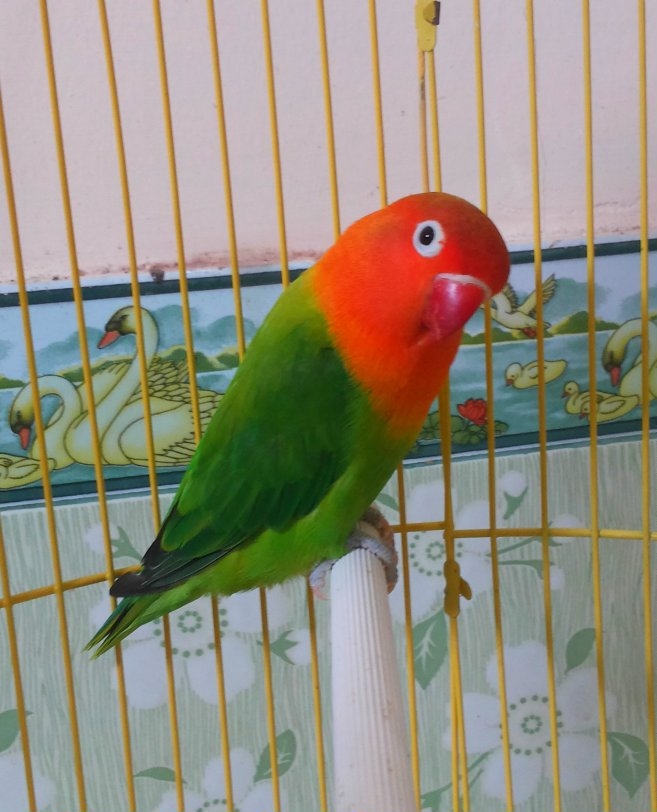
Opaline Fischeri Courtesy Joely Exotic LB
Opaline Fischeri
Courtesy Joely Exotic LB

Lovebird Colors & Mutations

Lovebird Colors & Mutations

Peachfaced lovebirds come in a variety of colors. Below are some photos. They are all Agapornis roseicollis. Remember, color mutations occur within the same species of lovebird, so you should never mix species! See below for some more information on the nine species of lovebirds

Male. Mother: American Cinnamon Violet Peachfaced Lovebird;

Lovebirds (Agapornis)

Lovebirds (Agapornis)

http://www.angelinasnest.com/_borders/Yellow%20Fischer%27s.jpgLovebirds are very popular pets and are a good for first-time bird owners.

These birds are great pets for older children but may be a bit too nippy for younger children.
They are quiet birds, so they can live in an apartment with you. They can also be friendly with all members of your family if they are hand-fed and socialized from a young age. They can become nippy as they mature if they are not properly or consistently handled. They need to be kept singly or they will bond with each other rather than you.